
Introduction
Armour Value 14 is the current vogue for the more meta armies, both in terms of containing heavy transports and the most efficient way of dealing with them. Most of the cookie-cutter armies out there will have at least one (usually two or more) big AV14 all-round transport, and a number of points-efficient ways of dealing with them. In this article, I’m going to take a look at a few specific Heavy Armoured and Light Armoured platforms in game and have a discussion about their utility, strengths and weaknesses – and why I like them so much in narrative themed armies. These aren’t necessarily “The best” but they’re the ones for me that just add that little va-va-voom to the game.
Lords of War
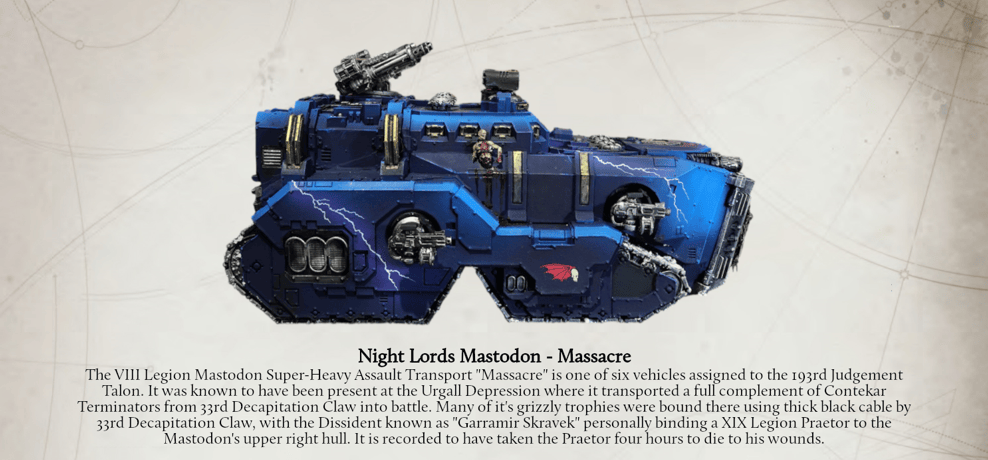
Mastodon Super-Heavy Assault Transport (Liber Hereticus. Pg 120, 600pts)
Strengths
- Platform Flexibility. The choice of sponson weapons on offer enables you to create Anti-Infantry, Generalist or Anti-Tank profiles relatively easily.
- Resilience. The Mastodon’s defensive profile is very good with 20 HP at AV14, Smokescreen and 2x Void Shields at AV14.
- Transport Capacity. 42 TC is great, but the flexibility of the Mastodon Transport Bay can enable some interesting narrative combinations.
Weaknesses
- No Auto-Repair. Tolerate the risk of Shock (Pinning) stopping you dead and Shock (Suppressed) neutering your firepower or take a Techmarine/Forgelord to mitigate.
- Disembark Rule RAW. Discuss with the Event Organiser or opponent beforehand.
- Void Shields/Glances. It’s not invulnerable and Voids can give you an illusion of that early game. Despite being resilient it can be brought down by glances in the later game.
- Tactical Flexibility. There isn’t much – it’s a one target tank and all of your eggs are in that massive basket.
- Package Cost. Its not terrible at 600pts but you need to be wary of the cost of the entire package, as you’re likely to end up closer to having 1/3-1/2 of your total points invested in it and its contents.
DISCUSSION
Starting off with a true goliath of the tabletop, the Mastodon Super-Heavy Assault Transport might seem like an odd choice, but it’s a model that is close to my heart. I’ve had a love/hate relationship with the Mastodon since 1st Edition, but one thing is undeniable – it’s presence. At approximately 30cm long and 12cm wide, it’s a unit and a half. This brings with it some limitations in terms of terrain density. Whilst we aren’t looking for the meagre and pathetic terrain seen in Warhammer 40,000 (god forbid that transparent American event terrain) – too much terrain can effectively stop the Mastodon from moving, or even being deployed. It’s definitely something that needs to be considered by both players and Event Organisers.
The Mastodon can accomodate up to 42 in its transport capacity, which lends itself to big squads – something the Night Lords both narratively and rules-wise can take advantage of. Terror Squads, Contekar and Night Raptors can be taken in squad sizes of up to 15, and whilst there can be a “feels bad” moment with Jump Infantry debussing from an armoured transport in terms of gameplay (and I steer away from it as a result), Terror Squads and Contekar are fair game!
Now you might say “Terrors are too expensive” and to this I say wholeheartedly – I agree, and there’s better things for them to go in and focus on doing that the Mastodon doesn’t really want to be doing. For instance, a Terror Squad in a Rhino or a Termite will be vastly superior to the Mastodon for moving to and harassing Line units and getting Vanguard off on. They’re easier to hide, move and can’t be seen coming a mile off. So that leaves us with Contekar in the Mastodon. The mechanics here are simple – drive up close, debus and get the Volkite Cavitators and Heavy Flamers in the action, set-up move (usually into combat) and go from there. This strength also comes with a weakness, whilst it can take up to 42 models to a destination, it’s very singular in terms of what it is targeting and what will target it. A lot of eggs, in one basket going to one target (usually).
How the Mastodon supports this is one of it’s great strengths. Barebones it comes with no sponson weapons selected, so if you took Heavy Bolters or Heavy Flamers, you’re running a big and resilient transport for 600 points. Better yet, those weapons, especially the Heavy Bolters, can lend their firepower to whittling down the target unit – without realistically increasing the likelihood of failing the charge. You’re circling close to 650pts for a Mastodon with Lascannon sponsons if you want something that can plink hull points off targets, then hopefully destroy the target enemy transport with it’s melta array. This isn’t surefire, and definitely requires some assistance from dedicated Anti-Tank.
The other benefit is the Mastodon Transport Bay – which enables up to 4 models (counting as 10 Capacity each) that do not exceed Bulky (6) to be taken inside it up to the maximum available transport capacity remaining. You could comfortably take 15 Contekar (30 capacity), a Centurion in Terminator Armour (2 Capacity) and a Contemptor Dreadnought (10 Capacity) internally. The weakness to this is that RAW, the Mastodon can only disembark one unit a turn due to how the disembarking rule is worded and that this is not changed by Super-Heavy rules. Well done Games Workshop on making a beautiful centrepiece model somewhat terrible out of the box by not bothering to look at rules interactions you created. Now I’d allow an opponent to just blob out all the transported units because it’s fairly obvious that is the intent with this platform, but one to check with Event Organiserbefore you start loading up on contents.
The Mastodon has 20 Hull Points at AV14, plus two Void Shields – which are effectively at AV14 too – as Voids no longer have a specified AV rating, they simply reduce the damage to 0 each time a penetrating hit is scored until their value is 0. They can’t be reignited, but that effectively gives you 22 Hull Points of AV14. Glances are a weakness however, as Void Shields don’t work against glances, and because it’s a Super-Heavy, you lose 1 Hull Point each time you would normally roll on the vehicle damage table. So whilst glances are unlikely to outright kill the Mastodon, and the Void Shields are targeted to stop dedicated Anti Tank fire, you should always consider how many glances your Mastodon has left in it, especially in the late game.
The weakness of a Mastodon under fire is in terms of Shock (X) weapons, specifically Shock (Pinned) and to a lesser degree Shock (Suppressed). The latter is an issue if you’re foregoing dedicated AT choices to fit the Mastodon in with four Lascannon sponsons, the former is a major issue as it’ll simply stop your movement dead in its tracks. Mastodons don’t have Auto-Repair (X), so are reliant on either rolling a 6 to repair in the Statuses sub-phase at the end of your player turn, or via a Techmarine/Forgelord.
I love mine – and they’re always a sight to behold on the table. There’s something abjectly horrific about a Mastodon, grinding slowly forwards, knowing that you’re going to die horribly to either it’s guns and tracks, or what nightmares it is about to bestow upon your position from its cavernous transport bay.
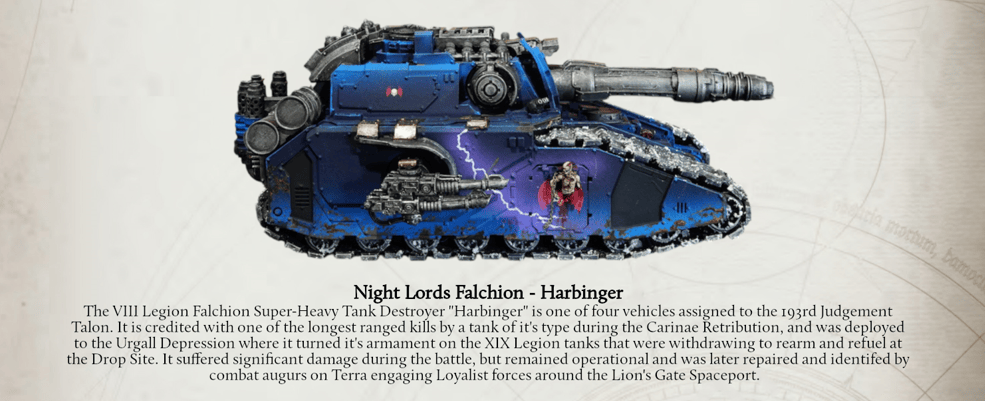
Falchion Super-Heavy Tank Destroyer (Liber Hereticus, Pg 117, 650pts)
Strengths
- Firepower. The Neutron-wave cannon is a brutal weapon for a brutal age.
- Resilience. The Falchion’s defensive profile is good with 18 HP at AV14/13/12 and Smokescreen.
- Decurion Magna. Overwatch/Return fire and Auto-Repair (4+) for 60 points. Worth it in spades.
Weaknesses
- Firepower. There’s a very real risk of overkill and equally a very real risk of whiffing with the neutron-wave cannon, and that’s before considering the quad-lascannons.
- Tactical Flexibility. One tank, one target – two Primary shots.
- Cost. Its not terrible at 650pts when you consider what it can do, but it being nearly a 1/4 of your points with a Decurion Magna is a significant burden.
Discussion
The Falchion is another of my favourite looking tanks in the game. It’s fantastically good looking. In fact the only other Lord of War I like the look of is the Glaive, but that won’t be in today’s article – mainly because it’s still paying for the sins of 1st Edition. The Falchion is a super-structure tank of gargantuan proportions, it’s around 25cm long and 12cm wide, making maneuverability a concern. You’re also probably not hiding it particularly well.
It’s good then that the Falchion has a good defensive profile of 18 Hull Points at AV14/13/12. This means it really doesn’t want to get forwards and open up its sides and rear to dedicated Anti-Tank fire, but from the front it requires some serious attention to destroy it. Beware of deepstrike and drop pod melta teams as a result – but even seekers with combi-melta can be significantly problematic for it. I personally rate the Falchion, but be exceptionally wary of Knights, where the similarly costed Ascastus Porphyrion can destroy the Falchion in a heartbeat. Because of its reputation as top dog dedicated Anti-Tank, the Falchion will either be target priority one or written off as something your enemy won’t deal with. Decurion Magna is a 60pts upgrade that provides two major benefits to the Falchion. First you get Auto-Repair (4) to get rid of any Shock (X) statuses. Secondly you get to return fire or overwatch ANY unit, instead of just Super-Heavies etc. This is pretty good for an upgrade and considering an equivalent Tech Marine will cost you similar amounts, you really need to consider whether you want to threaten those Laser Vindicators/Venators, or whether you’re content to just repair.
The Falchion is a monstrous platform with most of its form taken up by a Neutron-wave cannon and the power supply for it. It’s effectively the premier Astartes Anti-Titan platform, which means it’s defacto the premier Astartes Anti-Tank platform. We aren’t talking efficiency here, but we are discussing the fact that if all goes well, it will be able to destroy any other Lord of War (sans Knights and Titans) in a single round of shooting. But this power isn’t without it’s weaknesses and limitations. You get 2 shots at BS4 – which is neither a certainty to hit, nor difficult to hit with. It’s the awkward area of “well, this can go one of two ways”, and causes you to swing somewhat violently between your best and worst roll outcomes. Sure it has two quad-lascannons as sponsons to back up the firepower, but it will either overkill a target, or tickle it pleasantly. On a 200-300pts model this might be problematic, but the swinginess on a 650-710pts model becomes significant. Mostly because when you really need it to do the job, it will whiff. Sods law.
There isn’t much flexibility in terms of loadout or tactics with this. It’s a brutally blunt object. Apply it to targets. If you want something more generalistic, look to the Fellblade. If the Mastodon is representational of grim inevitable horror, then the Falchion is representational of the bleak pointlessness of trying to fight back in a tank. Being cored out, without even seeing the enemy and being unable to respond with your own weapons is a horrific thought – that feeling of helplessness maximised and demonstrated as it fires into your lines to the left and right of you.
Sicaran Venator (Liber Hereticus, Pg 107, 170pts)
Strengths
- Firepower. The Neutron Beam laser is effective, and Shock (Surpressed) can really upset the enemy on a hit roll of 5/6.
- Fast. 14″ of movement at the cost of Ordnance (D) means you can hide it, pop out and cause chaos.
- Resilience. 6 HP at AV14/13/12 and Smokescreen gives good tactical flexibility, even in suboptimal situations.
Weaknesses
- Firepower. It’s 10pts more expensive than the offensively better Laser Vindicator and only really adds Shock (Suppressed) at the cost of dealing less damage.
- Resilience. It has the same Hull Points as a Laser Vindicator, but one less on the side armour (12 vs 13), so you’re forced to rely on movement and speed to avoid the side being targeted – negating firepower.
- Cost. With lascannon sponsons this gusts 200pts – which is not insignificant.
Discussion
Venators are another lovely design of tank. As stock they come with Heavy Bolter sponsons and a turret mounted Heavy Bolter alongside the main armament – the Neutron Beam Laser. Only the sponsons can be changed to mount all manner of Anti-Infantry armaments, but really you’re probably going to want the lascannon sponsons on it.
The Sicaran base defensive profile is nice, if a little underwhelming on the side armour. It’s a fast tank, so sacrifices are clearly needed to be made in the armoured triad of firepower/mobility/protection (pick 2). In such a way, it offers something different to the myriad cookie-cutter Laser Vindicator lists, and that extra 4″ means you can often get some decent movement and angles over the 4 turns of the game.
Firepower wise, the Neutron Beam Laser is a 36″, Strength 10, 2 Damage weapon. It also has Shock (Suppressed), Armourbane and is Ordnance (D). In isolation this is good, but unfortunately, when compared to the Magna Laser Destroyer, which is 36″, Strength 10, 3 Damage, Armourbane, Ordnance (D) all for 10 points less per platform core, you realise that the Laser Vindicator you’re shooting at can kill you with return fire with just one of its 2 shots if it stayed still, whilst you need both of your 2 shots to go through and to have stayed still to stand a chance of destroying it. That’s before you bolt on Lascannon sponsons in an attempt to counter the inevitable whiffs. Maybe you aren’t going to shoot at Laser Vindicators, which is a wise move, but the reality is, that the benefits of rolling a 5/6 to hit and the movement profile simply are outweighed by pure destructive capability of the cheaper, better armoured, only slightly slower tank.
That said, I think it is the gentlemen’s choice. You know when your opponent puts down a Venator that they haven’t just gone for the most efficient unit to remove the enemy – they’ve gimped themselves to show you what cool tanks look like and how narrative stories can be told when those 5/6’s to hit occur. I’d rather be a narrative-gimp than a meta-chaser.
Sicaran Arcus (Liber Hereticus, Pg 106, 200pts)
Strengths
- Firepower/Tactical Flexibility. Missiles for every target, Statuses for days – a Night Lords players wet dream.
- Fast. 14″ of movement and 36″ Missile range gives a 50″ threat range, virtually all of the table – great for deliberate or reactionary action.
- Resilience. 6 HP at AV14/13/12 and Smokescreen gives good tactical flexibility, even in suboptimal situations.
Weaknesses
- Cost. It’s 200pts base, which is notable – but it at least offers something interesting for that cost.
- Priority Target. They have a reputation from the sins of 1st Edition, and many will target them as a priority as a result.
Discussion
The Sicaran Arcus is quintessential Horus Heresy aesthetic diluted down into perhaps the most generalist tank in the game.
Much the same as the Sicaran Venator, the Arcus has a good defensive profile with speed that enables it to pop out and do damage, but also reposition quickly and hide effectively.
Firepower wise, the Arcus is notable for its array of missile warheads. Roughly speaking, these can be broken down into:
- Arcus Warhead – FP5, S8, 2DMG – Generalist light/medium armour or Terminators/Automata.
- Skyspear Warhead – FP3, S8, 2DMG, Armourbane, Skyfire, Rapid-Tracking – Supposed to be for Anti-Aircraft, but suspiciously good at intercepting deepstriking Terminators, Drop Pods etc with Rapid-Tracking enabling missile use during Intercept.
- Pyrax Warhead – FP1, S5, 1DMG, Blast 5″, Panic (1) – Really good for softening up targets and applying statuses for A Talent For Murder.
- Neutron-flux Warhead – FP3, S7, 1DMG, Shock (Suppressed). Just hit on a 5/6 and watch that tank no longer be able to fire at full Ballistic Skill.
Of the four then, two Warheads allow us to apply statuses to targets, though the mechanism of application and the targets are very different. The other two are general purpose warheads that offer a lot of flexibility into targets under different mechanisms of the game, shooting vs interception. It’s not the same “Anti-everything” that the Demolisher Vindicator is and is a significant chunk of what a Kratos would cost, but it occupies a niche of “I can help” quite comfortably.
I love mine, using them to prepare the battlespace for next actions, be that softening an enemy troop formation with pyrax, as a reactionary unit to deepstrikers or just dealing other targets such as Rhino chassis platforms with that 50″ threat range.
I’ve had 2 since they released in 1st Edition, and it is rare that I leave them behind – they offer so much to me. You can imagine though, a pair of Arcus moving across the battlefield, loosing barrage after barrage of missiles into targets, forcing infantry to disembark shattered vehicles, before drowning them in pyrax in the next wave. The moments grace, an incoming flyer to rescue your beleaguered unit, and the dismal devastation of skyfire warheads ripping it from the air, and having it’s carcass smash into your position.
Sabre Strike Tank (Liber Hereticus, Pg 107, 80pts/90pts – Neutron Blaster)
Strengths
- Firepower. The Neutron blaster is a lascannon on crack. Fun, and horrific at the same time.
- Fast. 16″ of movement enables aggressive actions.
- Flexibility. Can take an Anvilus Autocannon or Volkite Saker primary armament for Anti-Infantry work, and has a plethora of secondary weapons to amp up its capabilties.
Weaknesses
- Firepower. Misfires on the Neutron blaster are painful.
- Resilience. Less resilient than a Rhino.
Discussion
The Sabre Strike Tank, a one-Astartes vehicle that offers some interesting play. The defensive profile of this vehicle is particularly weak. It’s the same Armour Value as a Rhino (AV12/11/10) but only has 4 Hull Points to the Rhino’s 5. This is offset by its movement, which is clearly part of its defensive profile at 16″. It’s also Vehicle (Rapid) which means it can rush an extra 6″ and still make attacks as snap shots. That gives it a threat range of 40-46″ depending on whether you want to snap shoot or not, and a reposition speed of 22″ if you’re just moving to position to respond to a new threat next turn. That’s monstrously good.
Firepower wise, you get the Anvilus Snub autocannon and Volkite Saker as free options, and you’re paying 10pts for a Neutron blaster. I prefer mine with the latter, as it gives me some 2nd line Anti-Tank. The Neutron blaster is FP1, S9, 3DMG, Armourbane, Shock (Suppressed), Overload (1) – which gives it good Anti-Tank capabilities but this doesn’t come without limitations. Overload (1) means that any roll to hit of a 1 are rolled against the Sabre’s lowest armour value and that Damage 3 gets applied to itself. Unless you roll a 1 – you’re basically going to kill yourself. Risk vs Reward! The Autocannon is deliciously good fun too with Breaching 5+ on that FP3, S7, 2DMG statline. It means it’s quite capable of positioning well to target Terminators effectively. If you want something that can drown lesser squads in firepower, running the Volkite Saker, with a Volkite Culverin (+15pts) secondary will give you 9 shots at Deflagrate (6). There aren’t any major detractions from these weapons like the Neutron blaster – adding to their value.
The Sabre Strike Tank is a lovely little platform that doesn’t get a large amount of play mainly because it’s awkwardly placed in the Recon role and is an expensive small resin model. I have a plan to run two Neutron and two Autocannon Sabres in a list alongside their bigger brothers. I think because they’re not often seen they will either be considered rubbish and not targeted or considered exotic and targeted, either way is a win because it’s either allowing them to do their job or taking firepower away from more dangerous units in my army.
You can imagine operating in a built up or ruined environment, patrolling quietly, then suddenly being ambushed by over-weaponed tankettes with brutal and blistering firepower. That fear of ambush, fear of the unknown, a prevailing thought of horror that the collapsed building at the end of the street might just be your death, waiting for the opportune moment to open fire.
Conclusion
So there we have it, my breakdown of my favourite Armoured units in 30K 3rd Edition. There’s a bit of a theme going on, what with the Falchion, Venator and Neutron Sabre in the article, but they do look absolutely lovely. I’m not saying these tanks I’ve listed are actually any good or “auto-takes”, this isn’t a competitive article. However if you’re going off aesthetics alone, you can do a lot worse!
My Glaive Special Weapons Tank is in the loft in storage, and I hope that one day it’ll make it to the table again. I just find that with the Night Lords, we have enough that can mulch infantry as it goes – and I don’t need a 650pts tank to do the same as a 200-400pts unit can. Maybe I’ll repaint it into the new scheme and release an update to this – because it is by far the most beautiful Lord of War tank Games Workshop have produced. If that Volkite Carronade were S8 AP2 2DMG instead of S8 AP3 2DMG that might actually make it significantly better and actually worth its baseline points.
Until that time, my Falchion is an OG Forgeworld model, and so are both Arcuses and one of my Venators. It’s time they all got replaced by plastics for ease of transport and gaming, so off to Wayland and Element Games I’ll go and place some orders.
I might do a painting tutorial for my Night Lords using the plastic Falchion, as I’ve been asked a few times about the scheme.
Thanks for reading! What are your most enjoyable or most aesthetically pleasing units to put on the table?
AVE DOMINUS NOX!


Leave a comment